
Last month, Vic and I took Michael to the Allentown Art Museum.
You know how these family outings go—everyone’s got different ideas about what sounds fun. Michael was hoping for interactive exhibits. Vic was looking forward to the contemporary art section.
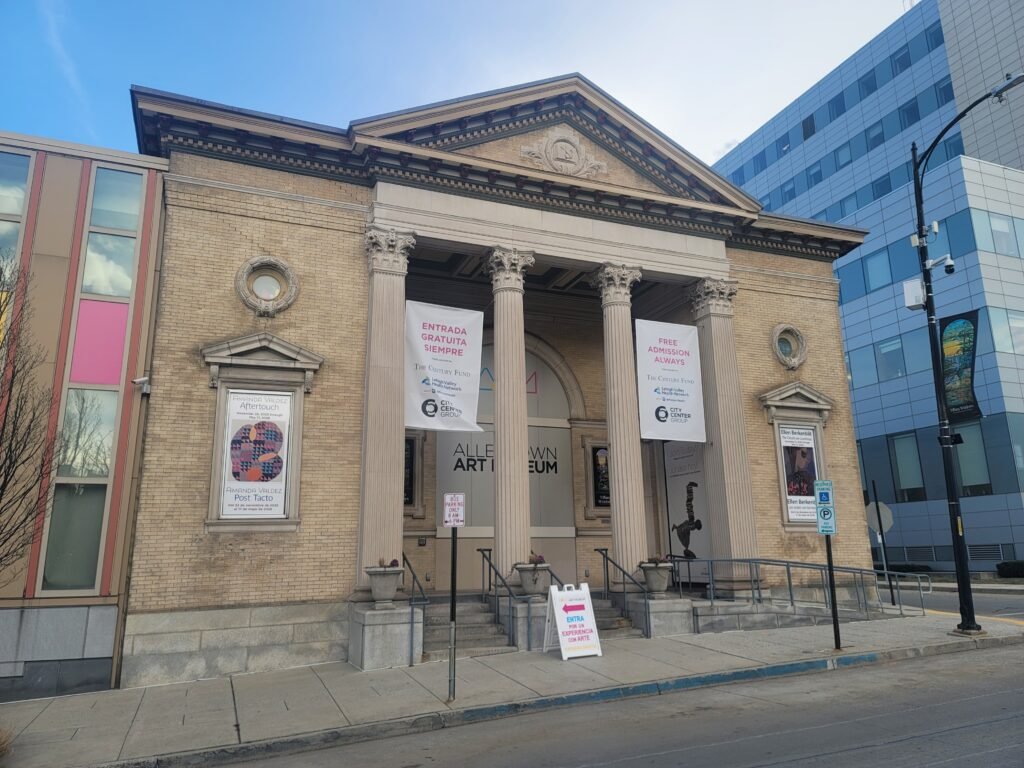
And me? Well, I was just hoping we’d all enjoy ourselves without anyone getting cranky.
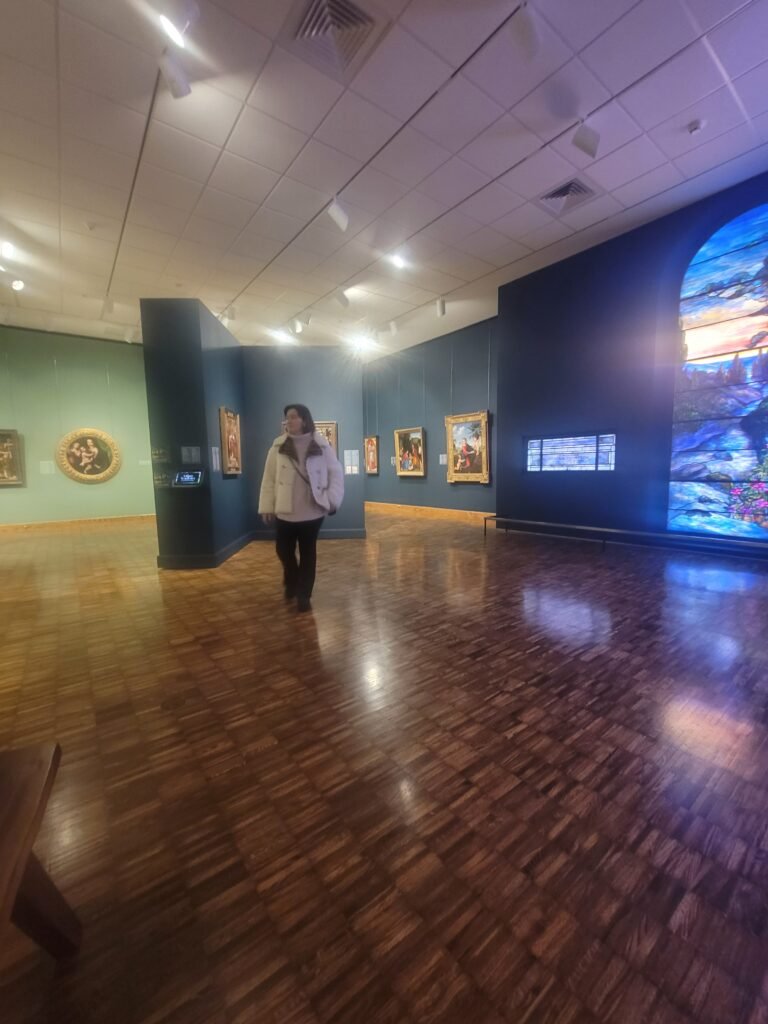
But then we walked into the gallery housing the Tiffany windows.
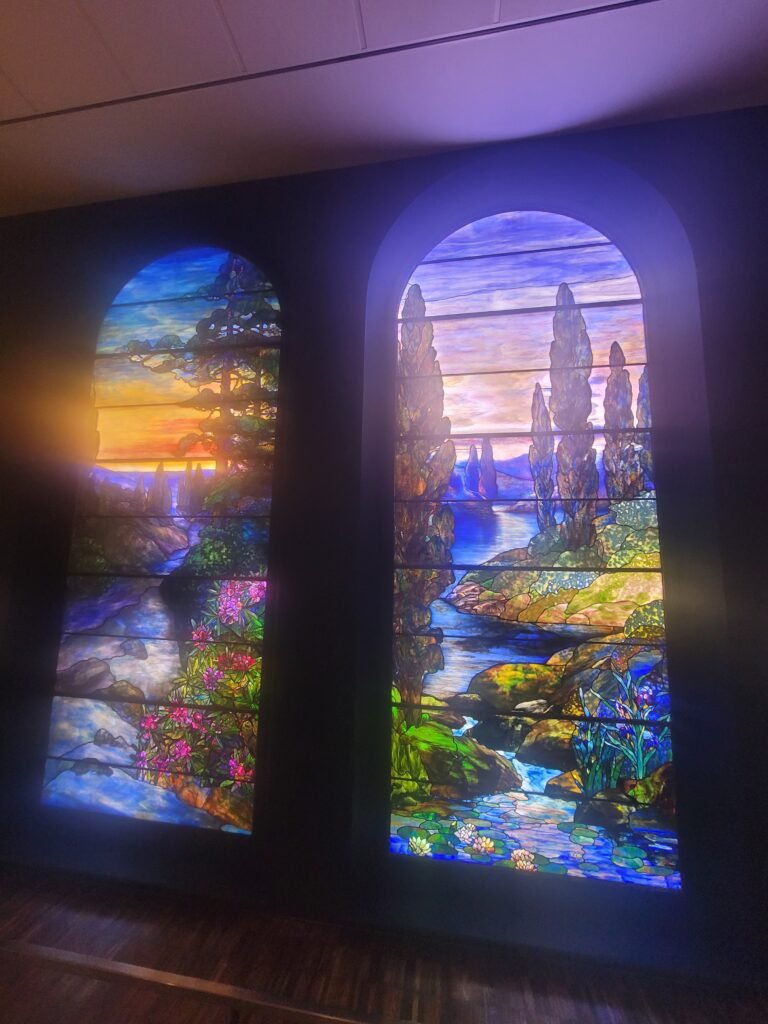
I stopped mid-sentence. The Thompson and Derr memorial windows rose before us like frozen prayers, their jeweled surfaces catching the afternoon light. The inscription on the first window seemed to glow: “Ho, every one that thirsteth, come ye to the waters.”
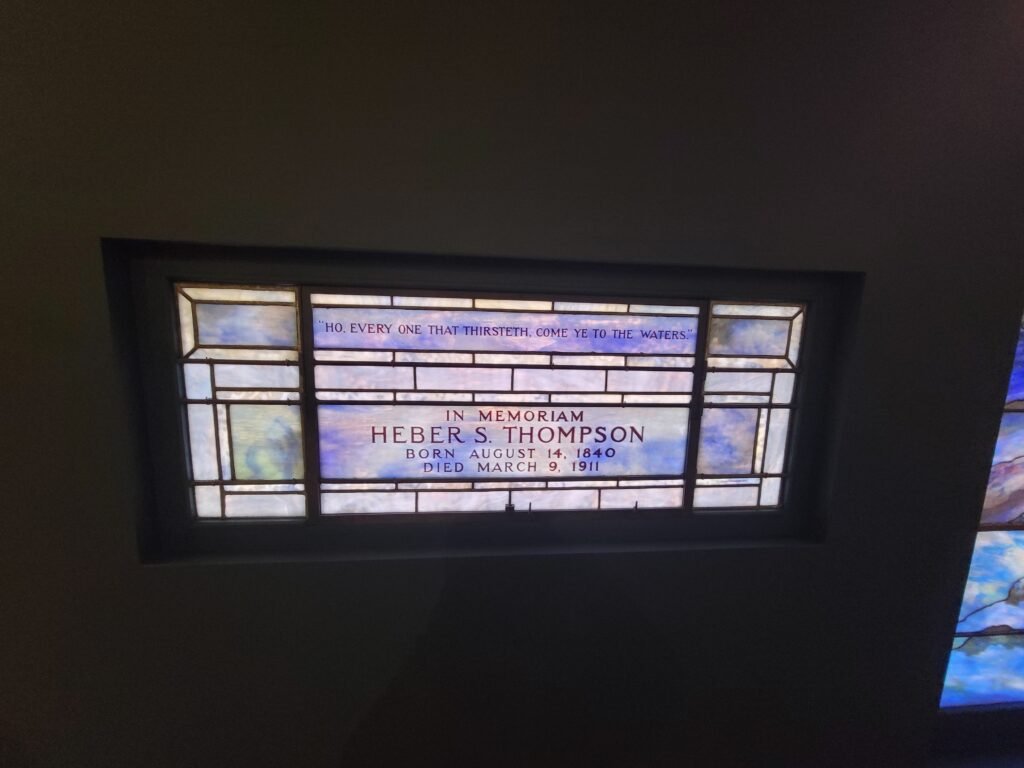
Something stirred in my heart. Here was a Union soldier’s story, told in glass and light—a man who’d seen the worst humanity could offer, yet chose to memorialize hope.
The Soldier’s Thirst: Heber Thompson’s Story
Heber S. Thompson graduated from Yale in 1862, right into a nation tearing itself apart.
At twenty-two, he could have stayed home, found a safe profession, maybe taught school or worked in his family’s business. Instead, he enlisted in the Union Army.
I tried to picture this young man marching through Pennsylvania, Virginia, maybe as far south as Georgia. The Civil War wasn’t some distant conflict we read about in history books—it was brutal, up-close horror.
Men died of disease as much as bullets. They marched until their feet bled through their boots. They watched friends fall and wondered if they’d ever see home again.
What kind of thirst does a soldier develop? Not just for water, though that’s real enough when you’re carrying sixty pounds of gear under a blazing sun. But there’s a deeper thirst—for peace, for safety, for the assurance that this nightmare will end.
Standing in that museum, I wondered about the moments when Heber Thompson first heard those words: “Ho, every one that thirsteth, come ye to the waters.”
Maybe it was during a Sunday service in camp, with the chaplain reading from Isaiah while artillery rumbled in the distance.
Maybe it was in a field hospital, whispered by a dying friend who still believed God’s promises were true.
Those words became his lifeline. Not because they promised an easy life, but because they promised a God who sees our deepest need and meets it.
After the war, Thompson came home to build a life. He became a church elder, married, had children. But he never forgot what sustained him during those dark years. When it came time to memorialize his faith, he didn’t choose triumphant battle scenes or patriotic imagery. He chose water.
“Ho, every one that thirsteth, come ye to the waters.”
You know what strikes me? Thompson could have memorialized his trauma. He could have created something that said, “Look what I survived.” Instead, he created something that said, “Look who sustained me.”
I’ve been thinking about my own seasons of spiritual drought. Times when my prayers felt like they hit the ceiling and bounced back. When I wondered if God was really listening, really caring about the mess I’d made or the pain I couldn’t fix.
Maybe you know that feeling too. That bone-deep thirst for something real, something that lasts. We try to quench it with busy schedules, social media likes, shopping trips, even good things like family time or church activities.
But there’s still that parched place in our souls that nothing seems to reach.
Heber Thompson discovered what Isaiah proclaimed centuries earlier: God doesn’t just offer water—He invites everyone who thirsts to come.
Not just the spiritually mature, not just those who have their lives together. Everyone. The broken, the weary, the confused, the guilty.
The invitation is personal. It’s urgent. And it’s free.
Thompson lived to be seventy-one years old. He had decades to reconsider that window’s inscription, to maybe choose something more sophisticated or theologically complex.
But he never did. Because sometimes the simplest truths are the most profound.
Come to the waters. Just as you are.
The Art of Divine Craftsmanship: Tiffany’s Process
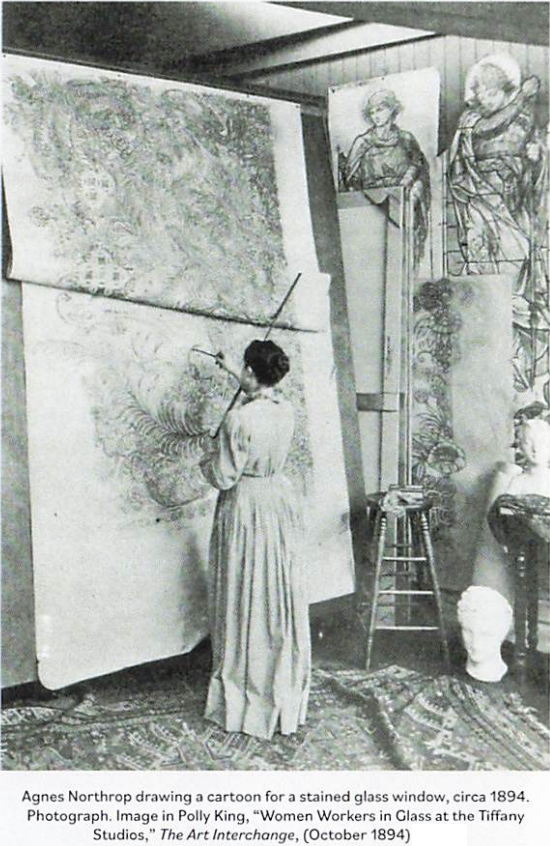
Studying those windows, I became fascinated by how they were made. The museum placard explained Agnes Northrop’s design process, and honestly, it sounded a lot like how God works in our lives.
First, she’d create a small watercolor—just a glimpse of what the finished window might become. From that tiny vision, she’d develop a full-scale cartoon, then trace it and cut it into templates for each piece of glass.
Isn’t that how God often works with us? He gives us small glimpses of what He’s creating—a moment of peace during chaos, a unexpected kindness from a stranger, a verse that jumps off the page at exactly the right time. We see fragments, but God has the complete cartoon spread out before Him.
The glass selection process amazed me. Tiffany’s artisans had access to what the museum called “a kaleidoscopic variety of colors and textures.” But they didn’t just grab any pretty piece.
Each fragment was chosen for its specific qualities—how it would transmit light, how it would interact with neighboring pieces, how it would serve the overall composition.
God does the same thing with our experiences. That difficult season you went through? That wasn’t random suffering.
God selected it for specific qualities—maybe to develop your compassion, maybe to strengthen your faith, maybe to prepare you for a ministry you couldn’t have imagined.
The acid-etching process particularly caught my attention.
Artisans would coat flashed glass with wax resist, then dip the entire sheet into hydrofluoric acid. It was dangerous and expensive, but it created details impossible to achieve any other way—shadows in the sky, the delicate texture of pine needles.
Sometimes God allows acid-etching seasons in our lives. The divorce papers. The cancer diagnosis. The job loss. The prodigal child.
These experiences burn away what we thought we needed, revealing patterns we never knew were there.
I remember when my father died at forty-eight. I felt like God had dipped my whole life in acid. Everything I’d assumed about fairness and protection got stripped away.
But years later, I could see how that loss etched compassion into my heart that I’d never had before. It gave me a ministry to other grieving families that I couldn’t have had otherwise.
Tiffany Studios also used a technique called plating—layering up to four sheets of glass to create depth and modulate color. Each layer was carefully selected for texture, translucency, and color based on the desired effect.
God layers our experiences too. The childhood lessons about perseverance. The young adult struggles that taught us to pray.
The midlife challenges that deepened our faith. The golden years that brought wisdom. Each layer adds depth and beauty to who we’re becoming.
The windows used Tiffany’s signature Favrile glass—the name comes from the Latin word for “hand-wrought.” Skilled craftsmen experimented with minerals, blended molten colors, rolled and manipulated the glass to create unique textures.
We’re God’s Favrile glass. Hand-wrought. Each of us shaped by divine hands that know exactly what minerals to add, what colors to blend, what pressure to apply.
The process isn’t always comfortable, but the result is something that transmits His light in a way no one else can.
Finally, copper foil held it all together. Stronger than lead strips, copper foil allowed for intricate, organic lines that contributed to both structure and beauty.
God’s love is our copper foil. It holds all our broken pieces together, creates strength from fragility, and allows for growth patterns that surprise everyone—including us.
Beside Still Waters: Sarah Ann Derr’s Legacy
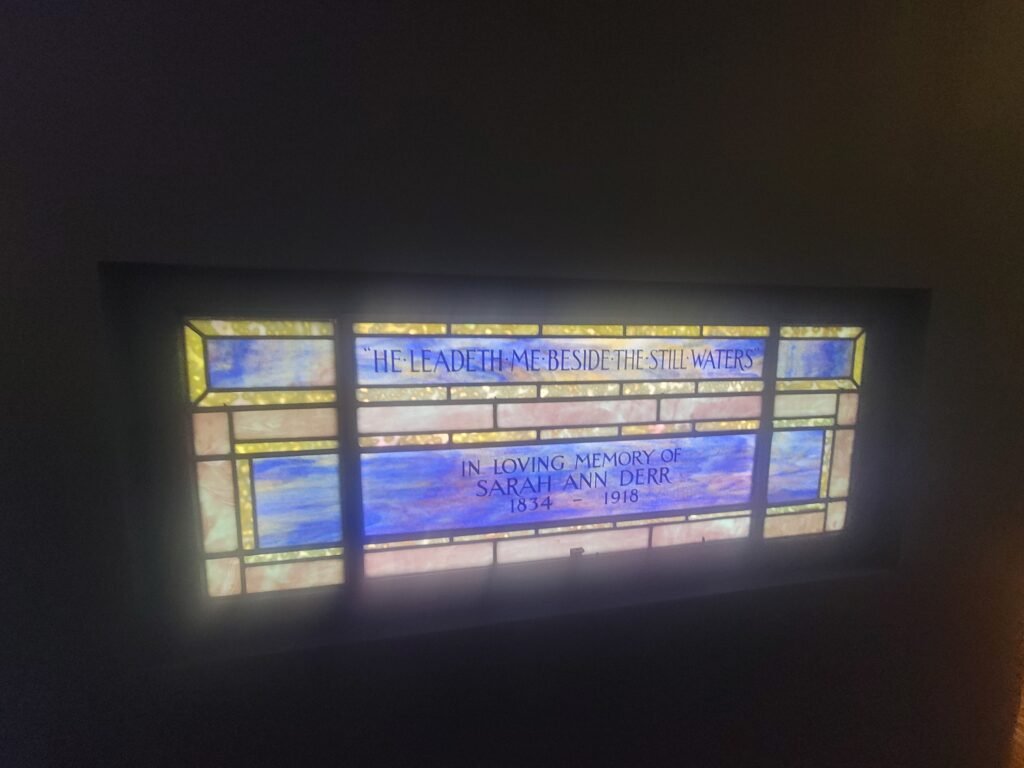
The second window memorialized Sarah Ann Derr, who lived eighty-four years—from 1834 to 1918.
Think about everything she witnessed: the Civil War, Reconstruction, the Industrial Revolution, the Spanish-American War, World War I.
She saw the invention of the telephone, the automobile, electric lights.
Through all those decades of change and upheaval, someone who loved her chose to remember her with these words: “He leadeth me beside the still waters… He restoreth my soul.”
Still waters. Not rushing rapids or crashing waves, but quiet pools that reflect the sky.
I used to think still waters sounded boring. Give me adventure, excitement, something happening! But Agnes Northrop understood what Sarah Ann Derr’s family knew—sometimes what our souls need most is stillness.
The window shows amethyst irises in various stages of bloom. Some are tight buds, others fully opened, still others beginning to fade.
It’s the cycle of life captured in purple glass, and it’s beautiful precisely because it includes every season.
Sarah Ann lived through all those seasons. Young motherhood with its sleepless nights and endless energy.
Middle years with their responsibilities and challenges. Later decades with their losses and limitations. The irises remind us that each stage has its own beauty, its own purpose in God’s garden.
But here’s what I love about still waters—they’re not stagnant. Stagnant water breeds mosquitoes and smells terrible. Still waters are different. They’re fed by underground springs, refreshed by gentle streams, cleaned by their own depth.
God’s still waters in our lives work the same way.
That quiet morning with your coffee and Bible? Still waters.
The peaceful conversation with a friend who really listens? Still waters.
The moment in church when a hymn touches something deep in your soul? Still waters.
Like everyone else, I’ve had my own still waters moments—those unexpected times when God’s peace breaks through the noise of daily life and restores something in my soul I didn’t even realize I’d lost.
Sarah Ann Derr probably had moments like that too.
Maybe while hanging laundry on the line, watching her children play in the yard, sitting on her porch in the evening.
Ordinary moments when God’s presence felt as real as the chair she was sitting in.
The beautiful thing about still waters is that God leads us there. We don’t have to manufacture peace or work up tranquility.
He knows when our souls are parched, when we’re running on empty, when we need restoration more than activity.
Sometimes He leads us beside still waters through circumstances—a canceled meeting that gives us unexpected quiet time, a snow day that forces us to slow down, an illness that makes us rest whether we want to or not.
Sometimes He leads us there through His Word—a psalm that speaks directly to our situation, a verse that we’ve read a hundred times but suddenly see with new eyes, a promise that feels like it was written specifically for our current struggle.
And sometimes He leads us there through people—a friend who offers to watch the kids so we can take a walk, a spouse who suggests we skip the evening plans and just sit together, a pastor who reminds us that being still is not the same as being lazy.
Sarah Ann Derr’s window reminds us that restoration is not a one-time event. It’s an ongoing process, like those irises that bloom and fade and bloom again.
God keeps leading us back to still waters because He knows we need regular restoration.
The Light That Transforms: Living Water Today
The museum’s lighting program changes throughout the day, revealing different aspects of the windows as shadows shift and colors deepen.
Standing there, I realized this is exactly how God’s light works in our lives—constantly revealing new facets of His character, new depths of His love.
When morning light hit the Thompson window, the inscription seemed to shimmer with invitation.
By afternoon, the deeper tones brought out the complexity of the landscape. Evening light made the whole scene glow with warmth and promise.
Our spiritual lives work the same way. God doesn’t reveal everything at once—that would overwhelm us. Instead, He illuminates truth gradually, season by season, experience by experience.
What looked impossible in the harsh light of morning might reveal new possibilities in the gentle glow of evening reflection.
Jesus called Himself living water, and I’m starting to understand why that metaphor is so powerful. Regular water satisfies temporarily—we drink it and get thirsty again.
But living water changes us from the inside out.
It becomes part of who we are.
I think about all the things I’ve tried to use as substitutes for living water. Busyness, to feel important.
Shopping, to feel better about myself. Social media, to feel connected. Even good things like family activities or church involvement can become substitutes if I’m looking to them for what only God can provide.
The difference is sustainability. Those other things require constant refilling, constant maintenance.
But when Jesus becomes our living water, He creates springs within us that keep flowing even when external circumstances dry up.
Last year, when Vic was recovering from his second surgery, I discovered this truth in a new way.
I couldn’t fix his pain or speed up his healing. I couldn’t control the medical bills or the insurance complications.
But I could draw from the living water that had sustained me through previous difficult seasons.
Some mornings, I’d sit with my coffee and just breathe prayers I couldn’t put into words.
I’d read the same psalm over and over until it soaked into my worried heart. I’d remember other times when God had been faithful, other seasons when He’d provided exactly what we needed.
That’s living water at work—not dramatic miracles necessarily, but the steady, reliable presence of God that keeps flowing even when everything else feels uncertain.
Here in Pennsylvania, we know about seasonal changes.
Spring streams that rush with snowmelt. Summer brooks that slow to a trickle. Fall waters that reflect golden leaves. Winter ice that preserves life underneath until warmth returns.
God’s still waters in our lives follow similar patterns.
Sometimes His peace flows like a rushing stream, carrying away our anxieties with obvious power.
Sometimes it’s barely a trickle, just enough to sustain us through dry seasons. Sometimes it seems frozen, but underneath, life continues.
The key is learning to recognize these different forms of God’s provision.
When Michael was struggling with anxiety about college applications, God’s peace didn’t come as dramatic reassurance.
It came as small daily reminders—a encouraging text from a friend, a verse that seemed written for our situation, the simple grace of family dinner conversations that reminded us what really matters.
Agnes Northrop designed those windows to be responsive to changing light, and that’s how our lives should be too.
Responsive to God’s light as it shifts and changes, revealing new aspects of His character we’d never noticed before.
The hand-wrought process continues in our lives long after we first come to faith.
God keeps experimenting with new minerals in our character, blending different colors of experience, rolling and manipulating circumstances to create textures that reflect His light in unique ways.
Sometimes I feel like I’m still in the acid-etching phase—circumstances that burn away my false securities, revealing patterns of dependence on God I didn’t know were there.
Other times I sense the layering process, as God adds new experiences that deepen my understanding and increase my capacity to transmit His love.
The copper foil of His grace holds it all together, allowing for growth that’s both structured and organic, both strong and beautiful.
Our lives become stained glass windows for others to see God’s light.
Not perfect, polished presentations, but authentic displays of how divine light transforms ordinary materials into something extraordinary.
When people look at our marriages, our parenting, our responses to disappointment and loss, what do they see?
Do they see living water at work, or just our own efforts to hold things together?
The encouragement for those currently in difficult seasons is this: God sees the finished window even when you can only see scattered pieces of glass.
The acid-etching process isn’t punishment—it’s preparation for beauty you can’t yet imagine.
The layering of difficult experiences isn’t random—it’s creating depth that will allow God’s light to shine through you in ways that comfort others walking similar paths.
Carrying the Light Forward
Walking out of the museum that day, I carried something new—a changed perspective on suffering and beauty, on how God works in the ordinary materials of our lives to create something extraordinary.
Those windows will outlast the people who commissioned them, the artisans who created them, and probably the building that houses them.
But the truth they represent is eternal: God transforms our thirsts into testimonies, our struggles into stained glass that reveals His glory.
Maybe you’re in an acid-etching season right now. Trust the Master Artist. He knows exactly what He’s creating, even when the process feels overwhelming.
Maybe you’re being layered with experiences that feel too heavy to bear. Remember that each layer adds depth and beauty to who you’re becoming.
Look for God’s still waters in your daily Pennsylvania life—in morning coffee, evening conversations, the changing seasons outside your window.
Let Him lead you there regularly, because restoration isn’t a one-time event but an ongoing gift.
And when people look at your life, may they see living water at work—not perfection, but transformation.
Not easy answers, but enduring hope. Not stagnant religion, but springs of grace that keep flowing no matter what storms may come.
Father, for those who thirst today, remind them of Your invitation. Lead us all beside still waters. Restore our souls. Make us windows that reveal Your light to a world desperate for hope. Amen.